_edited.png)
Living Benefits Term Life Insurance Explained
Here is the rewritten section, crafted to sound like it was written by an experienced human expert.
Life insurance is something most of us think of as a "what if" plan for our families after we're gone. But what if it could also be a lifeline for you during a serious health crisis? That's the powerful idea behind term life insurance with living benefits.
In short, it’s a type of life insurance policy that lets you tap into your death benefit while you're still alive if you get seriously sick. It’s life insurance you don't have to die to use.
A Financial Safety Net for Life's Biggest Curveballs
For a long time, traditional term life insurance worked one way: you passed away, and your beneficiaries received a payout. It's a crucial piece of financial planning, but it was designed for a single, final event. It offered zero help if you were diagnosed with a devastating illness that wiped out your savings long before you died.
This is where term life with living benefits completely changes the conversation. It adds a whole new dimension of protection, turning a standard policy into a more flexible financial tool for your entire family.
More Than Just a Payout After You're Gone
So, how does it actually work? These policies come with built-in features, usually called accelerated death benefit riders, that kick in if you experience a major health event. These riders give you the option to access a large chunk of your own death benefit to handle the immediate financial fallout.
Let's paint a picture. Say you have a heart attack or get a cancer diagnosis. Suddenly, you're facing a mountain of medical bills, and you might not even be able to work. A living benefits policy would allow you to file a claim right then and there. The money you receive can be a game-changer, helping you cover those costs without draining your retirement accounts or putting your family in debt.
It's important to remember this isn't a substitute for good health insurance. Think of it as a powerful partner. Health insurance pays the doctors and hospitals, while living benefits give you tax-free cash to use on anything—from covering your mortgage and utility bills to paying for experimental treatments your health plan won't touch.
Understanding the Core Protections
Most policies with living benefits are built around three main triggers. While the exact definitions can vary by insurer, they generally cover these situations:
Critical Illness: This usually covers major events like a heart attack, stroke, invasive cancer, or major organ failure.
Chronic Illness: This kicks in if you can no longer perform at least two of the six "activities of daily living" (like bathing, dressing, or feeding yourself) without help.
Terminal Illness: This applies if a doctor certifies you have a short time left to live, typically between 12 and 24 months.
By including these protections, modern life insurance recognizes a simple reality: a serious illness can be just as financially devastating to a family as an unexpected death. It’s a smarter, more flexible approach that makes sure your policy is there for you when you need it most.
How You Can Access Your Living Benefits
It’s one thing to know your life insurance can help you out during a major health crisis, but it’s another thing entirely to understand how you actually get your hands on that money. A living benefits term life insurance policy isn’t just a document you file away; think of it as a financial tool you can actively use when things get tough.
When you use this feature, you're essentially getting an accelerated death benefit. This just means the insurance company gives you a portion of your death benefit now, while you're still living, instead of your family getting the full amount later. The whole point is to provide immediate financial relief right when you need it most.
This infographic breaks down the journey, from a health crisis hitting to you getting the financial support you need.
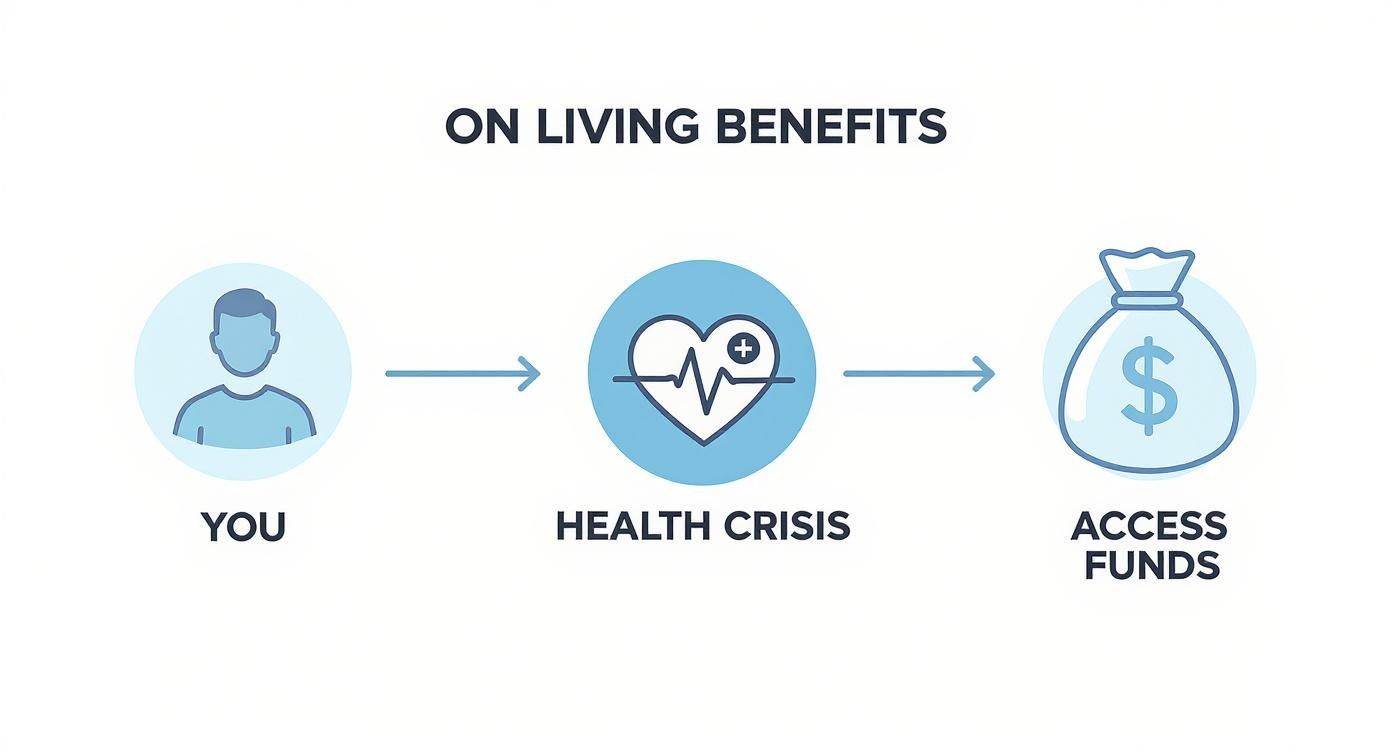
As you can see, a qualifying health event is the key that unlocks your policy's funds, turning it into a source of cash you can use during your lifetime.
The Three Main Triggers for Your Benefits
While the fine print can vary from one policy to another, most living benefits are activated by one of three serious medical situations. It's crucial to get familiar with these triggers because they are the gatekeepers to accessing your money early.
Terminal Illness Diagnosis: This one is the most clear-cut. If a doctor certifies that you have a limited time left to live—usually 12 to 24 months—you can file a claim. The idea here is to help you cover end-of-life costs and make your final months more comfortable without putting a financial burden on your loved ones.
Critical Illness Diagnosis: This covers those sudden, life-altering medical emergencies. We're talking about things like a major heart attack, a severe stroke, an invasive cancer diagnosis, or major organ failure. The money you receive can be a lifeline, helping pay for specialized treatments your health insurance won't cover or simply replacing lost income while you focus on recovery.
Chronic Illness Diagnosis: You'll typically trigger this benefit if you become unable to perform a certain number of the six Activities of Daily Living (ADLs) on your own. These are the basic tasks of self-care: bathing, dressing, eating, continence, toileting, and transferring (like getting out of bed). Most policies kick in if you can't perform two of these six ADLs without help.
It's a common mix-up, but living benefits aren't the same as long-term care insurance. While they can both help in similar scenarios, living benefits give you a lump-sum of cash to use for absolutely anything you want. That flexibility is a huge advantage over many traditional long-term care policies.
The Claims and Payout Process
So, what actually happens when you're faced with one of these diagnoses? Your first move is to contact your insurance company and start the claims process. You'll need to provide medical records and paperwork from your doctor to prove your condition meets the policy's specific definition of a qualifying illness.
Once your claim gets the green light, the insurer figures out how much to pay you. It’s important to know that you won’t get 100% of your death benefit. The offer will be a percentage of your policy's total value, usually somewhere between 50% and 90%. The exact amount depends on your life expectancy and how severe your condition is.
Basically, the insurer is calculating the present-day value of your future death benefit. For example, if you have a $500,000 policy, they might offer you a $350,000 lump sum now. If you take it, that cash is yours to use, and your remaining death benefit for your beneficiaries is simply reduced to $150,000.
This kind of flexible product design is becoming more common as the insurance industry adapts to real-world needs. The steady growth in individual life insurance sales in the U.S. points to a strong demand for policies that do more than just pay out after death. You can read more about the shifting trends in the global insurance market and how they're shaping the future of life insurance.
Living Benefits vs. Traditional Term Life Insurance
When you're shopping for life insurance, it's easy to get lost in the details. But one of the most important distinctions to understand is the difference between a traditional policy and one that comes with living benefits. At first glance, they look similar, but they operate on two completely different philosophies.
Think of it this way: traditional term life is a fortress built to protect your family after you're gone. A policy with living benefits is more like a dynamic financial shield, ready to protect both you and your family from different kinds of crises.
A classic, traditional term life policy is straightforward. It has one job and one job only: to pay out a death benefit to your loved ones when you pass away. It's a one-way street of protection that flows from you to your beneficiaries, but only after your life has ended.
On the other hand, living benefits term life insurance pulls double duty. It absolutely still provides that critical death benefit for your family. But—and this is a big but—it also opens up a portion of that death benefit for you to use while you're still living if you're hit with a major illness. Suddenly, your life insurance policy isn't just a posthumous safety net; it's an active part of your financial defense plan right now.

Living Benefits Term Life vs. Traditional Term Life
Seeing these two approaches side-by-side really helps clarify where they differ. The table below breaks down the core distinctions in how they function, who they serve, and when they can be used.
Feature | Traditional Term Life Insurance | Living Benefits Term Life Insurance |
|---|---|---|
Primary Purpose | Pays a death benefit to your beneficiaries after you die. That’s it. | Pays a death benefit and allows you to access a portion of it for yourself if you get sick. |
When It Pays Out | Payout is triggered only by the policyholder's death. | Payout can be triggered by death, or by a qualifying critical, chronic, or terminal illness. |
Who Gets the Money | Only your named beneficiaries can receive the funds. | You can become your own beneficiary during a health crisis. The rest goes to your family later. |
Flexibility | Completely inflexible. The policy has a single purpose and can't be used for life's emergencies. | Highly flexible. It’s both a death benefit for your family and a financial lifeline for you. |
Looking at the comparison, it becomes clear that a policy with living benefits offers a much wider range of protection.
Does It Cost More to Have Living Benefits?
This is the question on everyone's mind. With all this extra protection, surely it must cost a lot more, right?
You'd be surprised. Many of the best term life insurance policies available today include living benefits riders at no additional upfront cost. It’s become a standard feature.
Carriers know how valuable these benefits are, and to stay competitive, they’ve simply baked them into their standard products. You get a far more versatile and useful policy, often for the same price you would have paid for a traditional one. While some highly specialized riders might add a small fee to your premium, the potential financial rescue it offers can be worth far more than the minor cost.
How Do Living Benefits Stack Up Against Other Options?
Living benefits are a fantastic tool for handling the financial fallout from a serious health problem, but they aren't the only option out there. It’s also wise to consider how they compare to things like dedicated long-term care insurance home care policies.
A living benefits rider gives you a flexible lump-sum payment to use however you see fit—paying medical bills, covering your mortgage, or hiring a caregiver. A dedicated long-term care policy, however, is designed specifically to reimburse you for care-related expenses and often has different triggers and benefit structures.
Ultimately, the choice comes down to what kind of financial safety net you're trying to build. Traditional term life protects your family from your death. A living benefits term life insurance policy protects your family from the financial devastation of both your death and a major illness.
Who Needs Living Benefits the Most?
While living benefits term life insurance is a smart move for just about anyone, it’s an absolute game-changer for certain people. This isn't some complex financial tool reserved for the ultra-wealthy. It's a practical safeguard for everyday families who know that a sudden health crisis shouldn't have to mean financial ruin.
If any of the scenarios below sound familiar, you’ll want to pay close attention. These are the situations where this coverage can truly make all the difference, protecting your stability and your peace of mind when you need it most.
Sole Breadwinners and Single-Income Families
When one paycheck supports the entire household, the primary earner’s health is the family's most valuable asset. A sudden critical illness—a heart attack, a cancer diagnosis—can pull the rug out from under you in an instant. The income stops, but the bills don't.
This is exactly where a living benefits policy steps in, acting as a critical lifeline. It delivers a lump sum of cash that can cover the mortgage and keep the lights on, giving the breadwinner the breathing room to focus on getting better. Without it, a medical emergency can quickly become a financial one, threatening everything you’ve worked for.
A living benefits policy acts as a powerful financial backstop. It fills the dangerous gaps that health and disability insurance often leave behind, providing funds for lost wages, home modifications, or even experimental treatments your primary plan won't cover.
Entrepreneurs and the Self-Employed
If you work for yourself, you are your own safety net. There are no paid sick days, no employer-sponsored disability plans, and no corporate benefits to fall back on. If you can’t work, you don’t get paid. It’s that simple.
A living benefits term life insurance policy creates that missing safety net. If a serious illness puts you on the sidelines, you can use the accelerated benefit to:
Cover your personal living expenses while your income is on hold.
Keep your business afloat by paying overhead or hiring temporary help.
Avoid raiding your business assets or retirement funds just to make ends meet.
For an entrepreneur, this coverage isn't just personal protection—it's a business continuity tool.
Individuals with a Family History of Illness
Let's face it, genetics can deal us a tough hand. If conditions like cancer, heart disease, or other critical illnesses run in your family, you might be at a higher risk. You can't change your DNA, but you can absolutely prepare for the financial "what-ifs."
Locking in a policy with robust living benefits gives you a dedicated fund you can access if you receive a similar diagnosis down the road. It provides incredible peace of mind, knowing you have a financial plan ready to tackle the high costs of treatment without jeopardizing your family's future.
Anyone Worried About Draining Their Savings
You've spent years building your retirement accounts and other assets. The last thing you want is for one medical event to wipe it all out. Even with good health insurance, out-of-pocket costs for a major illness can easily run into the tens of thousands.
Think of a living benefits policy as a defensive wall around your wealth. It creates a separate pool of money specifically for a health crisis, so you don’t have to drain your nest egg. This is becoming more critical than ever; while life insurance ownership in the U.S. is around 51%, new premiums jumped 8% in 2025 as people seek smarter protection. You can explore more life insurance statistics to see how policies are changing to fit modern realities.
Understanding the Potential Downsides
While living benefits term life insurance offers a fantastic safety net, it's not "free money." It's crucial to go in with your eyes wide open, understanding the trade-offs. Accessing your benefits while you're alive directly impacts your policy and what you leave behind for your beneficiaries.
The most important thing to wrap your head around is this: using your living benefits shrinks the death benefit. It's a direct one-for-one trade. If you have a $500,000 policy and take out $200,000 to cover a critical illness, the death benefit for your loved ones is now $300,000. Simple as that.
This feature is a lifeline for a crisis, not a replacement for a savings account. Before you accelerate any funds, you have to weigh your immediate survival against your family's long-term financial security.
Navigating the Fine Print and Potential Costs
Beyond the smaller death benefit, there are a few other things to keep in mind. Insurance policies are legal contracts, and the details can vary wildly from one company to the next. Missing these details can cause major headaches right when you need help the most.
Here are a few key things to watch out for:
Administrative Fees: Some insurers charge a one-time fee when you access your benefits. It's usually taken right out of your payout, so the final amount you receive is a little less than you might expect.
Tax Implications: Here's a big one. Death benefits are almost always income-tax-free, but an accelerated benefit payout might not be. The rules can get complicated, and in some cases, the money you receive could be considered taxable income. We highly recommend talking to a tax professional before you make a claim.
Strict Qualification Criteria: Insurers have very specific definitions for what counts as a qualifying terminal, critical, or chronic illness. Just getting a diagnosis often isn't enough—your condition has to meet the exact language spelled out in the policy.
People often get confused about how these benefits fit in with other insurance products. The life insurance market is buzzing, with new premiums for whole life policies alone hitting $1.6 billion in Q2 2025. This shows that people are looking for policies that do more than one thing. While it's hard to find stats just for term life with living benefits, this trend makes it clear that consumers want flexible protection. You can read more about the strong growth in U.S. individual life insurance sales from LIMRA.
Asking the Right Questions Before You Commit
The best way to protect yourself is to know what to ask. When you're looking at a living benefits term life insurance policy, don't just glance at the premium and the death benefit. You have to dig into the specifics of the accelerated death benefit rider.
Before you sign on the dotted line, make sure you have clear answers to these questions:
What is this policy's exact definition of a "critical illness" or "chronic illness"?
What percentage of my death benefit can I actually accelerate? Is there a maximum dollar amount?
Are there any administrative fees for using this benefit? If so, how much?
How long is the waiting or "elimination" period before I can get the money?
By tackling these potential issues upfront, you can pick a policy with confidence, knowing exactly how it works and what to expect. This isn't about being negative; it's about being prepared so your safety net is there for you when it matters most.
How to Find the Right Living Benefits Policy

Diving into the world of insurance can feel like a maze, but zeroing in on the right living benefits term life insurance is more straightforward than it seems. The whole process really just boils down to a few key steps: figuring out what you actually need, checking out the best carriers, and teaming up with a professional who can help you lock in a great rate. It's a practical path to getting a policy that genuinely safeguards your family’s financial well-being.
Before anything else, the first step is to look inward. You need a clear picture of your life and finances to land on the right numbers. This isn't about guessing; it's about a realistic calculation.
Think of this as building the foundation for your search. It prevents you from overpaying for coverage you don’t need or—even worse—leaving your loved ones without enough protection.
Assess Your Personal Coverage Needs
Before you even glance at a quote, you need to nail down your ideal coverage amount and how long you need it for. Start by asking a few practical questions to find your "magic number" for the death benefit.
How much of my income would need to be replaced? A good starting point is to take your annual salary and multiply it by the number of years your family would count on it.
What are my biggest debts? Tally up your mortgage balance, car loans, student debt, and anything else you owe.
What big future expenses are on the horizon? This is where you factor in things like college tuition for the kids or helping with a future wedding.
When it comes to the term length, just match it to your longest financial responsibility. For example, if you have 25 years left on your mortgage, a 30-year term policy is a smart move. If your youngest is five, a 20-year term would see them through to financial independence.
Vet Insurance Carriers and Compare Policies
Here’s a crucial detail: not all living benefits riders are the same. Once you’ve figured out your coverage needs, your next job is to research insurance companies that are known for having solid living benefits. Some are simply more generous, with broader definitions of what qualifies as an illness or higher payout options.
Look for companies that:
Bake chronic, critical, and terminal illness riders into their policies at no extra cost upfront.
Have crystal-clear, fair rules for what triggers a claim.
Let you accelerate a high percentage of your death benefit, often up to 90%.
To really grasp how valuable these benefits can be, it helps to understand the real-world costs they can cover. For instance, learning how families pay for hospice care shows just how quickly expenses can add up. The money from a living benefit rider is designed to step in for exactly these kinds of situations.
The secret weapon for comparing multiple carriers at once is an independent agent. They aren't tied to a single company like a captive agent is, so they can shop the entire market for you.
This is a game-changer. An independent agent is on your team, not the insurance company's. They can pull quotes from dozens of top-rated carriers, pinpoint the policy that fits your health profile best, and walk you through the application to secure the most competitive rates possible. Their expertise is your best tool for finding the perfect living benefits term life insurance policy.
Frequently Asked Questions
It's completely normal to have questions when you're looking into something as important as life insurance. To help clear things up, here are answers to some of the most common questions we hear about living benefits term life insurance.
Is Living Benefits Term Life More Expensive?
You might be surprised to learn that it often isn’t. In fact, many insurance companies now include these features—often called accelerated death benefit riders—as a standard part of their term policies at no additional upfront cost.
Think of it as a competitive feature. To attract customers, insurers have started building this powerful protection right into their plans. While a few highly specialized riders might add a small amount to your premium, the value they offer during a serious health crisis usually makes it more than worthwhile.
The only way to know for sure is to compare quotes from different carriers. You'll see exactly who offers the best built-in protection for your budget.
How Much of My Death Benefit Can I Use?
There isn't a single, fixed number; it's a percentage that depends on your specific circumstances. Most of the time, you can access between 50% and 90% of your policy's death benefit.
Keep in mind, insurers usually have a maximum dollar limit on what you can take, which might be capped at $1 million or $2 million. When you file a claim, the insurance company will look at your current health and life expectancy to determine the exact amount they'll offer. Whatever you receive is simply subtracted from the final payout your beneficiaries will get.
Could Taking My Benefits Affect My Medicaid Eligibility?
Yes, and this is a really important point to understand. When you use your living benefits, you typically receive a large, lump-sum payment. This sudden cash infusion can be counted as an asset.
That new asset could easily push your total worth over the very strict limits for government assistance programs like Medicaid or Supplemental Security Income (SSI). The rules are complicated and vary quite a bit from state to state.
Because of this, it's highly recommended that you talk with a financial advisor or an elder law attorney before accelerating your benefits. They can walk you through the potential impact and help you make a decision that protects your overall financial well-being.
At America First Financial, our goal is to offer clear, straightforward protection that guards your family’s future while honoring your values. Let us help you find a policy that not only provides for your loved ones but also protects you during your lifetime. You can get a free, no-obligation quote in under three minutes and find the peace of mind you deserve.
Comments